







Sealing Fasteners: Methods & Applications
A leaking joint is often only apparent once it’s already caused a problem: corrosion under a panel, a contaminated batch, or a connector that fails a vibration test. To avoid this, design engineers need to choose a sealing method suited to the application. Several proven sealing methods exist, and comparing them side by side helps narrow the choice before a single part is specified.
Comparing Common Sealing Methods
Every sealing method trades off differently on installation labor, long-term reliability, and serviceability. Below are three of the most common approaches engineers evaluate for a fastened joint.
Sealants and Adhesives
Liquid or paste sealants fill gaps around a fastener after installation and cure into a barrier against moisture, dust, or chemicals. They’re inexpensive and adapt to irregular surfaces, but curing time adds a step to assembly. If rework is required, the old material must first be scraped away before the joint can be resealed. Consistent results also depend on proper curing conditions and how carefully the applicator dispenses the adhesive.
Gaskets and O-Rings
A gasket or O-ring compresses between two mating surfaces to block the gap. Material choice, per classifications such as ASTM D2000 for rubber compounds, determines how well the seal holds up to heat, chemicals, or repeated compression cycles. Gaskets perform well in flat, bolted joints, but they add a separate component to inventory and can shift or degrade if a joint is disassembled and reassembled often.
Self-Sealing Fasteners
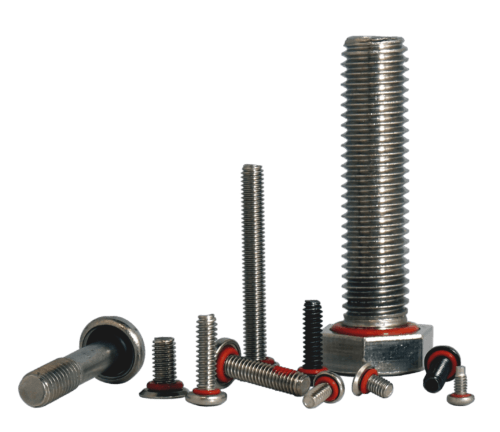
A self-sealing fastener features an elastomer molded directly onto the screw, bolt, nut, or washer, so the seal can be installed in a single step with no separate gasket or sealant. Torque compresses the built-in O-ring against the substrate, and the fastener can typically be removed and reinstalled without losing sealing performance. This makes self-sealing hardware, including sealing screws and bolts and sealing washers, a strong fit for equipment that requires periodic access, such as enclosures or panels rated to standards like IEC 60529 for ingress protection.
Choosing a Method by Application and Environment
The right choice among these sealing methods usually comes down to the environment and how often the joint gets opened. Before specifying a fastener, gasket, or sealant, weigh a few factors against the joint’s real-world conditions:
- Vibration and shock. Equipment that vibrates or absorbs repeated impact, including robotics and automation assemblies, favors a method that won’t loosen or migrate, such as self-sealing fasteners.
- Temperature range. Static, high-temperature joints may be better served by a compression gasket rated for that heat range rather than a sealant with a lower thermal ceiling.
- Access frequency. Panels or housings that technicians open and close often need a method that reseals cleanly on every reinstall, such as self-sealing fasteners.
- Assembly volume. High-volume production lines can save labor by using a self-sealing fastener that seals in one step instead of needing to apply and cure liquid sealant or install a separate gasket.
For sealing applications where technicians need repeated access—such as maintenance panels, junction boxes, and sensor housings—hardware that reseals on every reinstall simplifies the maintenance process and can eliminate the need for separate sealants or O-rings.
Why a Single-Source Sealing Manufacturer Helps
Sourcing sealants, gaskets, and sealing hardware from separate suppliers means qualifying multiple vendors and tracking several lead times for one assembly. A manufacturer that produces sealing applications across fastener types, elastomer chemistries, and custom configurations lets a design engineer specify from one source instead of coordinating several.
That’s the approach APM Hexseal has taken since 1947, building a portfolio of Seelskrews®, Seelbolts®, Seelnuts®, and Seeloc® washers alongside custom molding capabilities for projects that fall outside standard sizes.
Get Sealing Guidance From APM Hexseal
No single method wins every application, but weighing these sealing methods against your joint’s environment, access needs, and service life narrows the field quickly. APM Hexseal’s engineers can help evaluate which approach or self-sealing hardware configuration fits your specific design.
Explore our sealing hardware product guide to select a self-sealing fastener for your project.
Contact us to get started on a solution.